

Following through on a goal takes more than motivation. A workable goal has a place in your actual week, an action you can control and a way to restart after interruptions. Determination cannot create time, money or support that is not available.
Choose a goal you can explain in your own words
Ask why the goal matters to you now. “Everyone else is doing it” may reveal pressure more than a personal priority. A useful reason could be making a task easier, learning something you value or creating room for a responsibility.
Separate the outcome you hope for from the action you can take. You cannot guarantee a job offer, but you can prepare one application. You cannot make another person respond, but you can send a clear inquiry.
Define the next action and a finishing point
“Get organized” is difficult to schedule. “Put the school forms in one folder after dinner” tells you what to do and when you have finished. Use an action small enough to begin without a long setup.
- Action: What exactly will I do?
- Cue: What existing moment will remind me?
- Limit: How much time or effort is available?
- Finish: What counts as enough for this attempt?
For example: “After Saturday breakfast, I will spend twenty minutes choosing one course to investigate. I will stop after saving its requirements and cost.” This is an example, not a required duration.
Check resources before promising yourself more
Look at your time, equipment, transport, money and support. If a plan depends on childcare you do not have or a subscription you cannot afford, revise the plan before interpreting difficulty as laziness.
Use what is already available where it meets the need. Put the necessary file, contact details or equipment where you can find it. Reduce the work required to start rather than purchasing a new planning system automatically.
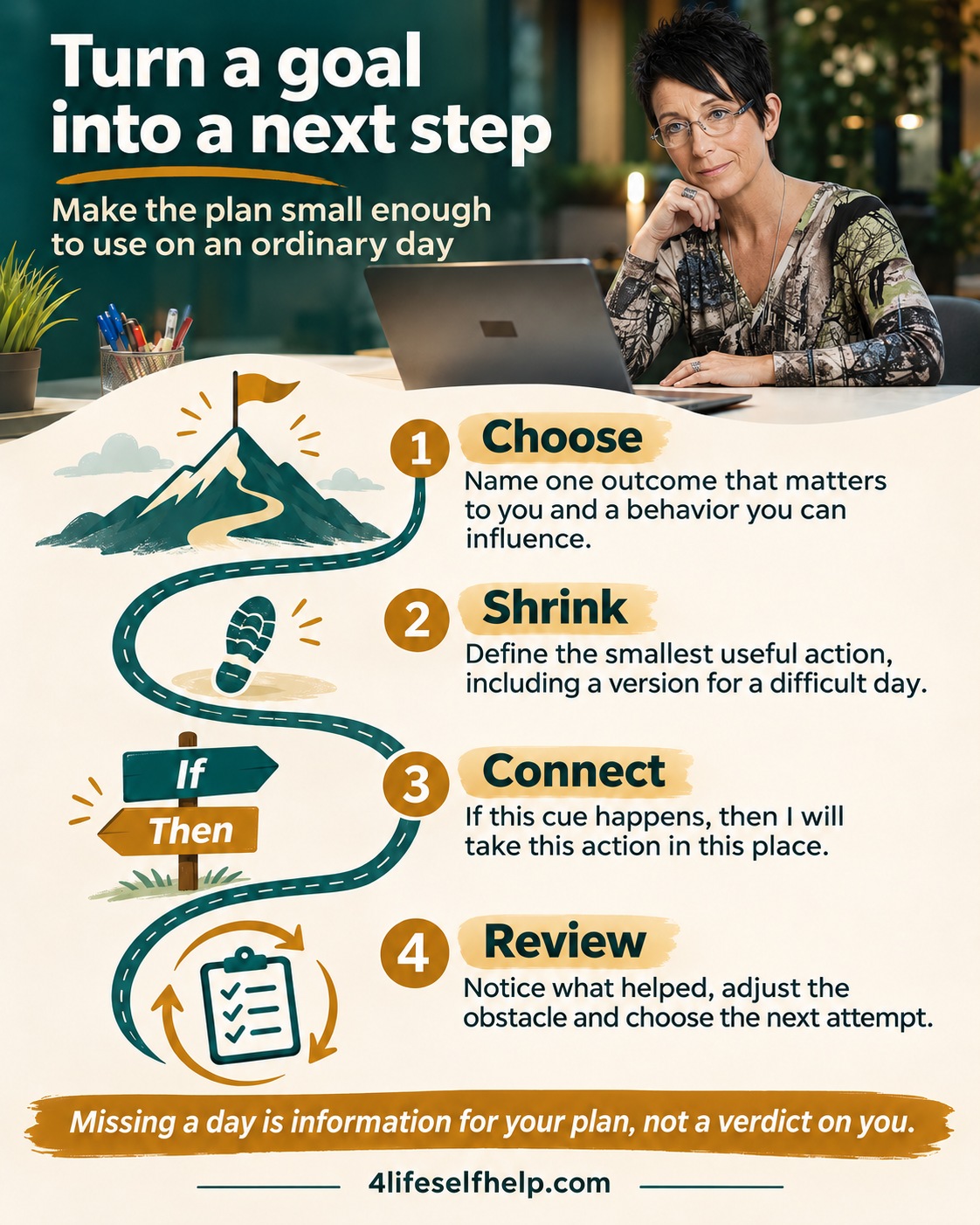
Read the visual guide as text
- Choose. Name one outcome that matters to you and a behavior you can influence.
- Shrink. Define the smallest useful action, including a version for a difficult day.
- Connect. If this cue happens, then I will take this action in this place.
- Review. Notice what helped, adjust the obstacle and choose the next attempt.
Missing a day is information for your plan, not a verdict on you.
Prepare a smaller version for busy weeks
A backup should preserve the purpose without pretending every week is the same. A full study session might become reading one page and noting a question. A weekly home project might become clearing the part that blocks everyday use.
Some weeks require a pause. The smaller version should not become another rule you punish yourself for missing. Illness, care demands and changing circumstances are reasons to reassess capacity.
Review the plan without making it a verdict
At a convenient point, ask three questions:
- What actually happened?
- What made the action easier or harder?
- What should I keep, change or stop?
A missed session may reveal an unrealistic time, an unclear task or a competing responsibility. Change the part that failed. Do not automatically add more reminders and stricter rules.
Track only information that helps you make a decision. A short note or a tick can be enough. A perfect streak is not necessary for useful progress.
Plan the restart before you need it
Decide what you will do after an interruption: identify the next available opportunity, choose the smallest useful action and check whether the goal still matters. Avoid trying to repay every missed session at once.
Accountability can help when it is chosen freely and stays specific. Ask someone to check on the action, not judge your worth: “Could you ask whether I contacted the course provider?” You can change that arrangement if it creates pressure without helping.
When several goals compete, choose which deserves attention now and which can wait. Revising or retiring a goal may be responsible when its cost outweighs its value. A good plan supports your life rather than becoming a test you must keep passing.