

A weekly personal life review gives you a consistent time to look at how your week went and decide what to do with commitments that are still open. Start with one observation, one next action and one thing that can wait.
Review the week without giving yourself a grade
Look at things in front of you like your calendar, a task you completed and then a conversation you remembered. Ask what took time and attention before you decide if you did enough.
Include work that people can’t see. Caregiving, travel, making appointments and recovering from a sickness can take up a lot of resources even if they don’t show a finished project.
Describe what you need, such as saying, “Two evenings had to be spent on unexpected tasks,” this is more information than saying something like, “I wasted my whole week.” The first thing can help you to create a plan, but the second one just is adding blame. You can be honest about missing a commitment and still see the conditions around it. Being accurate allows you to make better decisions instead of being hard on yourself.
Look for the conditions that helped
When you’re looking back over your week, try thinking about one thing that made your life a little easier and another thing that caused more problems than you expected. Sometimes paying attention to these small details can help you figure out what’s working and what you might need to change.
For example, maybe you started keeping all your important paperwork in one folder, which saved you time because you weren’t constantly searching for something you needed. But maybe you also had an appointment that wasn’t scheduled clearly, and you ended up spending more time sending messages and trying to figure out when you were supposed to be there. Think about why one situation worked better than the other.
Was it because you knew exactly what needed to be done? Did you have more time to complete something? Were you somewhere quiet where you could concentrate, or did you have someone helping you with the responsibility?
Review what you agreed to do
Another helpful way to review your week is by looking at the things you’ve promised yourself or other people that you would do.
Sometimes we agree to responsibilities without realizing how much time or effort they’ll require. Other times, we keep carrying things around on our to-do lists even when they’re no longer necessary.
Start by thinking about what you still need to accomplish and which responsibilities actually have a deadline. Are there things you need to finish soon? Is there something you agreed to do but never discussed when it needed to be completed? Have any of your plans changed since you first made them?
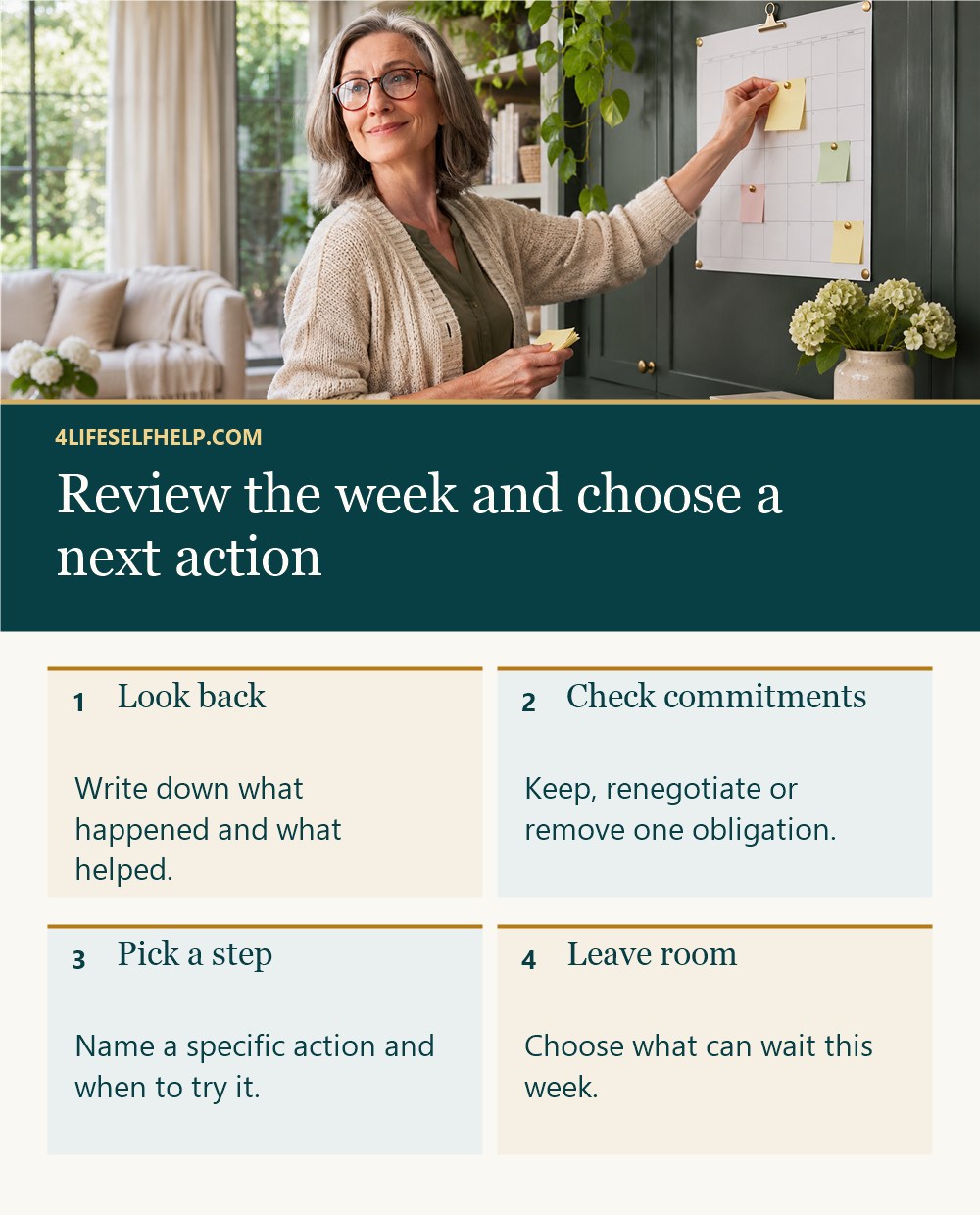
Read the visual guide as text
- Look back. Write down what happened and what helped.
- Check commitments. Keep, renegotiate or remove one obligation.
- Pick a step. Name a specific action and when to try it.
- Leave room. Choose what can wait this week.
Give needs and tasks separate space
Ask if the week allowed for rest, food, privacy, health care and activities that you enjoy in your life. You don’t have to keep track of every detail of what you did but pay attention to what disappeared.
According to the NHS guide to tackling a to-do list it emphasizes balancing routine, necessary, and enjoyable activities. Your review can use information while staying easy.
If the answer is that there was no space, look beyond your discipline. The week might be overloaded, and you might not have support. Pick a practical response, get rid of an optional commitment, ask for a handover or get information about a barrier. A review shouldn’t turn needs that aren’t met to saying that you failed at self-care. You can make these needs visible enough to plan around them next time.
Choose an action you can recognise
Write what you’re going to do and describe an action with an ending. You could say something like, “I’m going to work on my future,” but something better to say could be, “Find an application deadline on the website.” This is something you can actually do.
Set a realistic time when you can. According to the National Cancer Institute’s resource on implementation intentions it describes linking a situation with an intended action through an if-then plan.
You could try something like: “If I finish lunch at home on Thursday, then I can find the deadline and save the application link.” This is a cue that can happen and an action that fits a good time frame. This idea can also have a follow-through, but it doesn’t guarantee that it will. If the steps are still unclear or seem impossible, go back to something practical instead of adding a bigger promise.
Decide which task can wait
A review can make the list bigger unless you decide what’s going to wait, stay unchanged, or stop. Write down a boundary for your next coming week. You might decide to put off an optional project, refuse to go to an extra event, or decide that a household task doesn’t need to be done today. If another person is affected, though, talk about the change with them in the right way.
This makes your priorities visible. Saying yes to a course application might mean saying no to organizing a gathering that you wanted to do later in the month. The gathering isn’t unimportant, but it just means both tasks need to be scheduled at the same time. A good review allows you to make a choice instead of letting every good intention stress you out when your week is already overly crowded.
Deal with the task you keep carrying over
Have you ever noticed that you keep writing the same thing on your to-do list week after week without ever getting around to doing it? Maybe you’ve been meaning to organize a closet, start a new hobby, research something you’ve been interested in, or finish a project you started months ago.
Every week, you tell yourself that you’re finally going to get it done, but somehow, it ends up on the next week’s list again. When this happens, it might be time to think about why you haven’t completed the task instead of just continuing to move it forward.
Start by asking yourself if it’s still something you actually need or want to do. Sometimes our priorities change, and something that seemed important a few months ago might not matter as much anymore.
Resume after a missed week
If you miss a week, start with the current situation. You don’t have to go back and recreate every missing point before you make a plan for tomorrow.
Pay attention to immediate needs, deadlines, or one priority that you find important. Reducing your review might be all you need to do when you’re grieving, sick, or going through a hard situation. Taking a break doesn’t mean the method didn’t work.
After trying this a few times, ask if it earned its place. Did the review help you take action steps, clarify a commitment, or get rid of mental clutter? If not, change the timing, lengthen the question.
Write a short review you can repeat
- Write two things that happened and one condition that shaped them.
- Check what you promised, what still matters and which commitments need an answer.
- Choose a particular next action, the next time you can try it and what you will set aside.
If it helps, write the cue as an if-then statement. “If I sit down after Tuesday’s lunch, I’ll send the availability email.” The National Cancer Institute resource on implementation intentions explains how these plans pair a situation with a response.
Related reading. How to Set Personal Goals You Can Actually Follow Through.
Frequently asked questions
1. How long should a weekly life review take?
Start with 10 to 15 minutes or a single page. Stop once you have one useful next action and know what can wait.
2. What questions should I ask each week?
Ask what happened, what helped or got in the way, what still matters and when you can take the next step.
3. What do I do with unfinished tasks?
Decide whether each task still matters. Shrink it, ask for help, schedule it, renegotiate it or take it off the list.
4. Do I need a planner or app?
A notebook, calendar or simple note works. Use a format you can find again and keep private when it contains personal information.
5. How do I restart if I miss a week?
Begin with current deadlines, needs and commitments. Pick a small next action for the week ahead.