

Write a plan for an ordinary day when you feel motivated to make one. Give it a cue, a smaller version for busy days, and a clear point when you’ll pause or ask for help. You can use the same plan after the initial excitement fades.
Keep a reusable plan where you will see it
- Trigger
- The event that makes this action possible.
- Ordinary version
- The task you would do with typical time and energy.
- Fallback
- The small part that still helps.
- Pause
- The circumstance where rest, help or a revised deadline takes priority.
- Restart
- The next workable cue if today falls through.
Try the card for a week. If you keep missing the cue, change the time or location. If loss of interest or low energy is persistent or makes daily life difficult, a qualified health professional can help assess what is happening. The NIMH overview of depression discusses symptoms and options for support.
Write a first action you can see yourself doing
When you’re trying to accomplish something, it’s easy to make plans that sound good but don’t really tell you what to do next. You might write down goals like starting a project, getting organized, or learning something new. But these things can feel overwhelming because they don’t explain where you’re supposed to begin.
Instead of focusing on the entire goal, try identifying one specific action that will help you move forward. For example, if you’re thinking about going back to school, writing “research college programs” on your list might lead to hours of searching without making a decision. But writing “check the admission requirements for one college” gives you something you can actually finish.
You can use this approach with other responsibilities too. Maybe you need to complete an application, but you’re not sure where to start. Your first step might be opening the application and reading the instructions. If you need certain documents, you could make a list of what’s required and gather the ones you already have.
Give the action a dependable cue
A plan is easier when it shows an opportunity instead of relying on remembering at the right time. According to the National Cancer Institute’s resource on implementation intentions it describes linking a situation with a planned action.
Someone working a changing shift might plan after getting the roster instead of picking the same day. A practical cue respects the structures in your life and shouldn’t require a perfect morning or an uninterrupted evening that hardly ever exists.
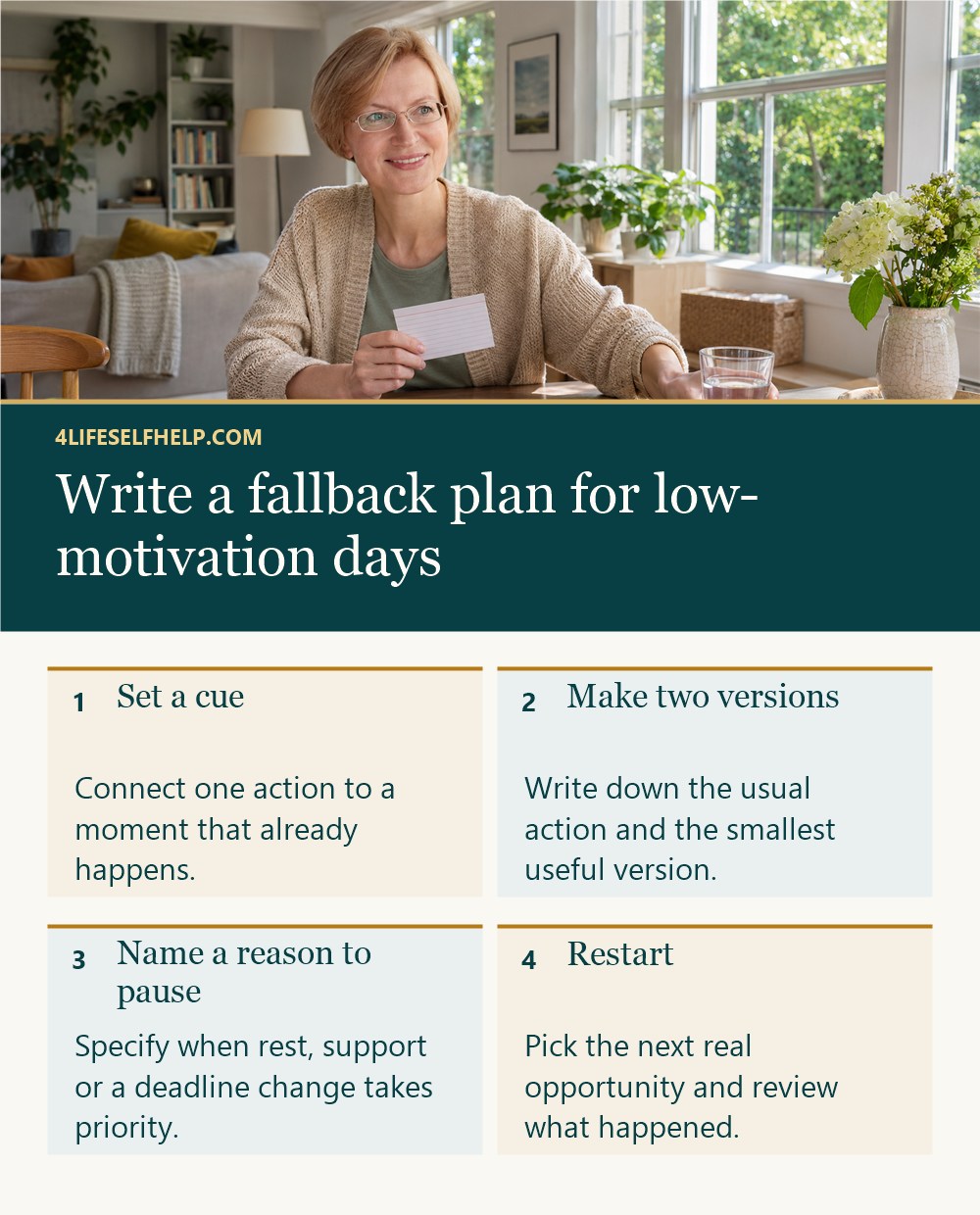
Read the visual guide as text
- Set a cue. Connect one action to a moment that already happens.
- Make two versions. Write down the usual action and the smallest useful version.
- Name a reason to pause. Specify when rest, support or a deadline change takes priority.
- Restart. Pick the next real opportunity and review what happened.
Set up only what helps the action happen
Sometimes getting started on something can be difficult because you have to spend time finding information, gathering supplies, or remembering what you were supposed to do next. When you’re already busy, having to figure everything out again can make a task feel more complicated than it needs to be.
One way to make things easier is by keeping the information or materials you need somewhere you can find them. For example, if you’re working on an online application, you might save the website, keep the necessary documents together, or write yourself a short reminder about which section you need to complete next.
Think of a woman named Melissa has been trying to finish an application for a new job. Every time she has a few minutes to work on it, she spends most of that time searching for the website and trying to remember where she stopped. Eventually, she saves the application link and writes herself a note that says, “Finish the work experience section.” The next time she opens the application, she already knows what she needs to do.
Make the smaller version explicit
Pick a smaller action that works with your purpose. If the usual plan is writing down a whole section, the reduced version might be getting the facts needed for one paragraph.
Be clear about when the reduced version works and when a full pause is needed. If you’re sick, have an emergency, or you’re exhausted, you might need to stop instead of completing a task.
Don’t make the minimum a new obligation that follows you in each circumstance. This is an option for interruptions, not a rule saying you are not allowed to rest. The plan needs to keep you able to respond with judgment. Some days, an action is a small step, and other days, it’s contacting someone, changing a deadline, or taking care of a need you have right now.
Write down when to stop or renegotiate
Sometimes you agree to do something and later realize that you won’t be able to finish it when you originally promised. Maybe another responsibility came up, the project is taking longer than you expected, or you’re dealing with something that makes it difficult to keep up. When this happens, it’s important to let the people who are depending on you know what’s going on instead of avoiding the conversation.
Think about if you’ve agreed to help a coworker prepare some information for an upcoming meeting. You originally promised to have everything ready by Wednesday, but your workload has increased, and you realize that you won’t be able to finish on time. Instead of waiting until Wednesday to explain, you could say, “I won’t be able to finish everything by Wednesday, but I can have the first part ready then and send the rest on Friday.”
Give yourself a way to restart
But it’s also important to think about what happens after your break. If you regularly tell yourself that you’ll return to something later but never do, you might need a clearer plan for getting started again. Maybe you need to decide which part of the task comes next or if there’s something making it difficult to continue.
Use a trial week to revise the plan
After you try, ask what happened: Did you start, what made it easier or harder, and what information did you gain? Then pick one thing that changed instead of trying to make everything different.
If the task didn’t get touched, look at the action, cue, resources, and capacity. You might need smaller steps, a better decision, or help from someone else. Don’t judge the plan just by your mood. You might have done a useful action while still not feeling inspired.
You can feel excited about a plan and still know that it’s not workable. The review should work with your intentions about what really happened and leave room to change, pause, or stop the arrangement.
Related reading. When Motivation Fades: Smaller Tasks, Rest and Support.
Frequently asked questions
1. How do I build a plan I can use when motivation fades?
Write an ordinary version, a smaller version and when you’ll use each. Connect the starting action to a cue you already encounter.
2. What is an example of an if-then plan?
If I sit down after breakfast on Tuesday, I’ll open the form and fill in the first field. If Tuesday falls through, I’ll use Thursday after breakfast.
3. How small should the fallback be?
Make it small enough for a busy day and useful enough to move the task forward. For example, write the first sentence or lay out the materials.
4. What if I keep skipping both versions?
Look at timing, resources, ability and whether the goal still matters. Remove a barrier, change the task or decide what support you need.
5. When is stopping or resting part of the plan?
You can set a clear pause condition before you start, such as feeling unwell or having another essential responsibility. Choose a next check-in if that would help.