

Getting to know yourself can begin with noticing what matters to you now: your preferences, needs, limits and the choices available in your everyday life.
You may change over time or feel different in different roles. These seven areas offer questions to explore at your own pace, with room for uncertainty and support.

1. Approach the past at a pace you choose
Your history may help you understand a preference or response, but you can begin with the present. You do not need to reconstruct every memory or identify a hidden trauma to understand yourself.
If looking back feels useful, choose a specific question and stop if the process becomes overwhelming. A suitable therapist can help you explore difficult experiences with support.
Mind’s guidance on coping with trauma explains that asking for support with current feelings does not require you to describe the traumatic event itself. You can choose what you share and when.
2. Describe values and preferences in ordinary language
Ask what you would like your choices to reflect: fairness, creativity, connection, reliability, curiosity or something else. Include ordinary preferences such as how much company, quiet or structure you enjoy.
Consider which expectations you have chosen and which you feel pressured to follow. Family, culture and responsibilities may all matter; understanding their influence does not require rejecting every part of your past.
Leave room for a mixed answer. You can value connection and need time alone, or enjoy change while wanting some stability.
3. Separate wants, needs and practical limits
Choose one area you would like to understand better. You might want a different work pattern, more time for an interest or relationships with clearer communication.
Ask what the change would contribute and what it would require. Time, money, access, health and caring responsibilities are relevant information when you consider an option.
Some choices may be available now; others may need resources or support. A limit does not make the wish unworthy, and wanting something does not guarantee that a particular outcome will follow.
4. Learn through a small experiment
Try a manageable version of an interest or change before making a major commitment. Borrow materials, ask a question, attend a short session or adjust one part of a routine.
Decide what you want to learn: whether you enjoy the activity, what support it requires or how it fits your day. Choose a time to review rather than treating the first attempt as a verdict about who you are.
You can continue, simplify or stop. Discovering that something does not suit you is useful information too.
5. Meet self-critical thoughts with specific questions
Notice an absolute statement such as “I never know what I want.” Ask what happened in the particular situation, what was unclear and whether you needed more time or information.
A fairer response might be, “I have two preferences that conflict,” or “I need to ask about the practical details before deciding.” This gives you a next step rather than an argument with your whole personality.
Feelings can be part of the information you consider. You can listen to them while checking facts, consequences and other people’s choices.
6. Practise compassion with limits
If helping someone is meaningful to you, choose a kind of help you can reasonably offer. Ask what the person wants instead of assuming, and include your own capacity in the decision.
You can care about someone and decline a request. A life that includes rest, personal interests or private goals does not become selfish because every activity is not directed toward someone else.
Notice whether an act of generosity feels freely chosen or driven by pressure. That distinction can help you understand your needs and relationships more clearly.
7. Choose relationships where you can be yourself
Look for room to express a preference, disagree respectfully and decide how much personal information to share. You can build different kinds of connection through friendship, shared interests, family or a community that fits you.
Ask for the kind of support you want: listening, practical feedback or company while you try something new. Another person’s perspective can be useful without becoming the final authority on your identity.
If uncertainty about yourself is causing persistent distress or affecting daily life, consider professional support. Getting to know yourself can remain an ongoing process, rather than a task you must finish before living.
Use a real choice to learn about yourself
Think about an invitation you recently accepted or declined.
- What appealed to you: company, learning, quiet, enjoyment or something else?
- What made the choice difficult: time, expense, expectations or uncertainty?
- What would you request differently next time?
Write your answers about this one event. A specific preference is useful even if it does not explain your entire personality.
When a regular social plan no longer fits
If you enjoy catching up but find big gatherings tiring, ask one friend to meet for a quieter activity. See what you appreciate when the format changes.
If expressing a preference feels risky in one setting, you can explore it privately, with someone you trust or in a different environment.
Read the infographic in text
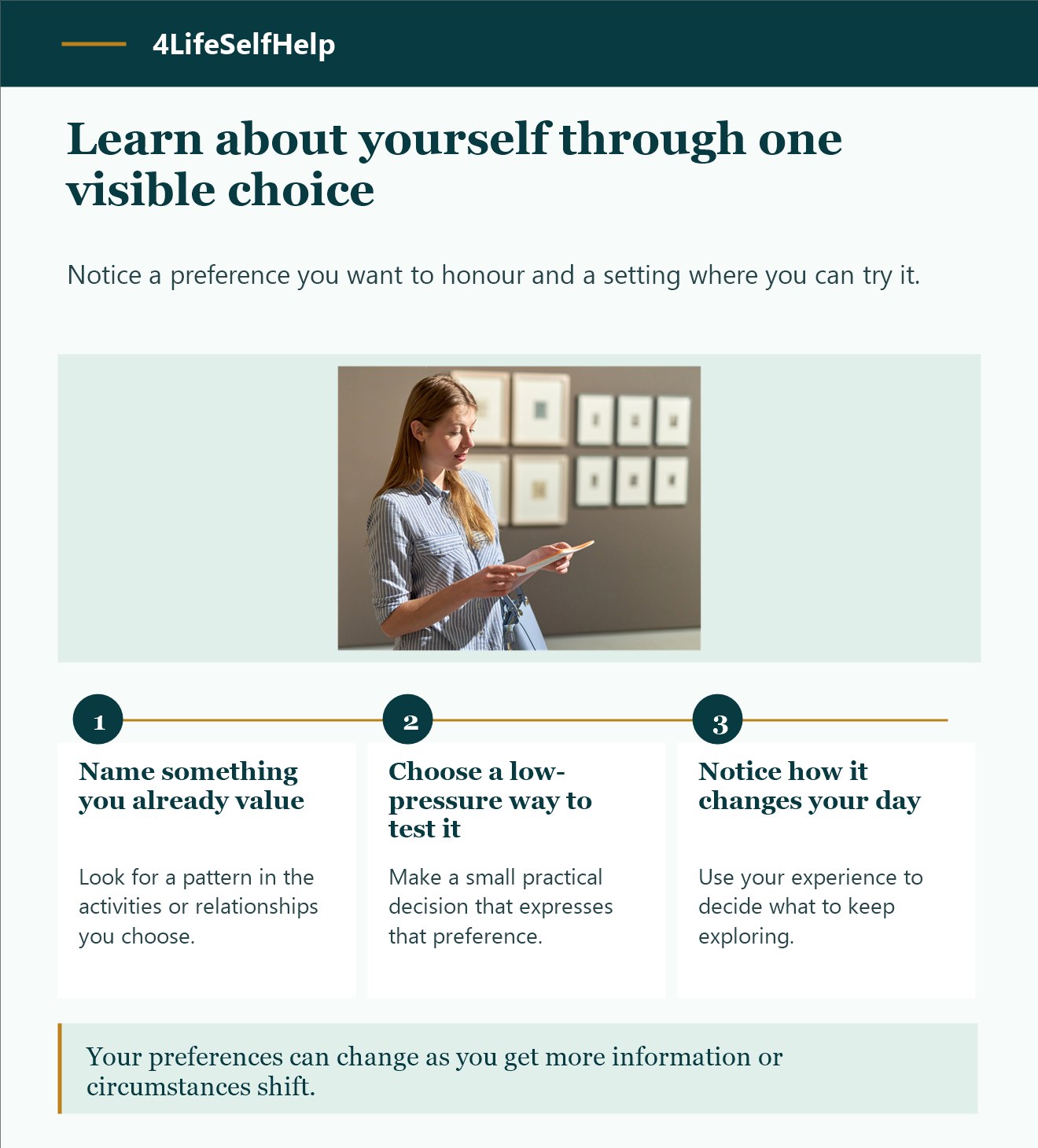
Learn about yourself through one visible choice
Notice a preference you want to honour and a setting where you can try it.
- Name something you already value Look for a pattern in the activities or relationships you choose.
- Choose a low-pressure way to test it Make a small practical decision that expresses that preference.
- Notice how it changes your day Use your experience to decide what to keep exploring.
Your preferences can change as you get more information or circumstances shift.